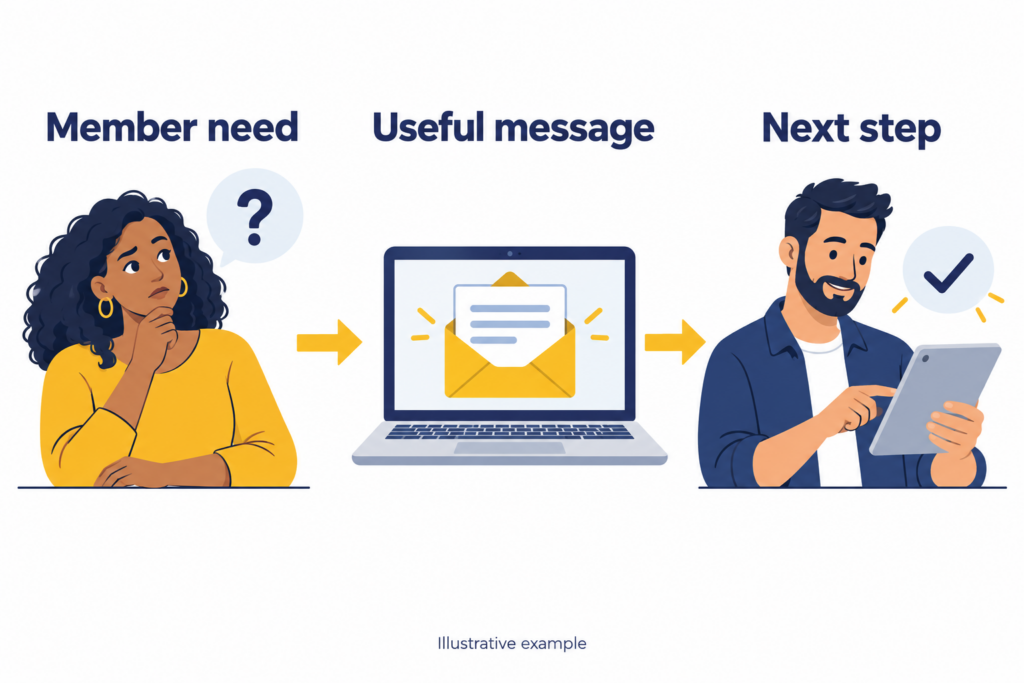
Credit union marketing tips are most useful when they connect a specific member need to a clear action. Start with a defined audience, helpful information, and a working next step; then review whether the communication helped.
A member joins your credit union, receives a welcome email, and then hears mostly about loan promotions. Another attends a budgeting workshop but does not receive the resource promised afterward. Both situations reveal an opportunity: make your marketing more useful at the moments members need help.
For a small team, that starts with choosing a specific audience, answering a real question, and making the next step easy. Member engagement might mean setting up account alerts, attending a workshop, requesting information, or using a service with confidence.
These ten credit union marketing tips connect your audience, messages, and channels to actions you can measure and improve.
Understand your members before planning campaigns
Start by grouping members around relevant needs and relationships with your credit union. New members may need onboarding help. Members who choose financial education updates may want practical guidance. People unfamiliar with digital banking may benefit from simple tutorials.
Use member surveys, common branch questions, and approved account information to identify useful groups. Avoid assuming that everyone of the same age wants the same products or prefers the same channel.
Then create short member personas: summaries of a group's goals, questions, and communication preferences. A useful persona might describe a new member who wants to move direct deposit but is unsure where to begin.
Record what that person needs to know, what could stop them, and the next action your message should support. Those details give your team something concrete to write around.
Planning a redesign? Let’s make it simpler.
Explore a website platform built for small credit union teams.
Give every marketing email a clear purpose
Decide what the reader should do before writing the email. A message explaining account alerts needs a different structure from an invitation to a community event.
Write subject lines that describe the value honestly. For example, “How to set up account alerts” tells a new member more than “Exciting news from your credit union.” Keep the opening focused and use a clear button or link that matches the promised action.
Personalize the content around relevant needs, rather than stopping at a first name. An onboarding email could link directly to setup instructions and explain where to get help.
Track useful clicks, completed actions, unsubscribes, and complaints alongside opens. Use accurate sender information and a working unsubscribe process; the FTC's commercial email guidance outlines the core requirements.
Make community outreach useful and easy to join
Choose community activities that connect your team's expertise with a local need. A library budgeting session, school savings activity, or employer benefits fair can give people a practical reason to speak with your credit union.
Ask the host what participants need before proposing a topic. Someone attending a first-job workshop may value an explanation of direct deposit more than a presentation covering every account you offer.
Give each event a clear purpose, an appropriate staff lead, and a useful follow-up resource. Make registration simple and explain whether attendees need to be members.
Afterward, review attendance, questions, and requests for further help. Use those questions to improve the next event and create content for members who could not attend.
Help people find and use your website
Every campaign needs a destination that fulfills its promise. Send an auto loan email to the relevant loan page, where visitors can find current information and understand how to proceed.
Review key pages for clear headings, readable rates, eligibility information, useful disclosures, and obvious contact options. Test menus, forms, and links on phones and with keyboard navigation. Fix obstacles before spending more to promote the page.
For local search, maintain accurate Google Business Profiles for eligible branch locations. Keep addresses, phone numbers, regular hours, and holiday hours current. Google's local ranking guidance emphasizes complete, accurate business information.
Give branch pages useful local details, such as parking, ATM access, and available services. That helps visitors decide where to go and what to expect.
Design mobile campaigns around convenience and consent
Review the whole campaign on a phone: the message, landing page, form, and confirmation. Check that text is readable, buttons are easy to select, and important details remain available on a small screen.
Keep mobile tasks manageable. Someone opening an event invitation should be able to see the topic, time, location, and registration link without searching through unrelated content.
If you use promotional SMS, have your compliance team approve the consent, recordkeeping, and opt-out process before launch. Make texting an intentional choice for members, explain what they will receive, and honor requests to stop.
Use recognizable sender information and avoid requests for passwords or sensitive account details. A phone number on file should not become your marketing team's default invitation to start sending promotions.
Personalize the next step with appropriate data
Segmentation identifies the audience; personalization changes the experience they receive. A new member might get onboarding guidance, while someone who requested homebuying resources receives a related workshop invitation.
Start with a small number of useful, explainable connections. Use information members have provided and data your organization has approved for that purpose. Avoid messaging that exposes sensitive circumstances or makes people wonder how closely their finances are being watched.
Review vendor access and proposed data sharing before building automated campaigns. NCUA's privacy guidance explains requirements involving consumer financial information and outside parties.
To evaluate personalization, compare the intended action across comparable groups and watch unsubscribes or complaints. If practical, test personalized and general messages with randomly assigned groups. Treat small results cautiously rather than declaring every difference a win.
Build partnerships around a shared activity
An ongoing marketing partnership needs a defined activity and clear responsibilities. For example, a local employer and your credit union could create a financial orientation session for new employees.
Agree on the audience, the resource or event, and what each organization contributes. One partner might provide the venue and invitations while the other develops educational materials and answers questions.
Plan cross-promotion through each organization's own approved channels. Do not assume a partnership permits exchanging member or customer lists. Review any referral arrangement and explain membership eligibility wherever prospective members are invited to join.
Use a dedicated registration page or referral question to understand participation. Start with one manageable collaboration, then decide whether the response and workload justify repeating it.

Ask for feedback and show what changes
Choose a specific moment to ask a focused question. After a workshop, ask which topic participants still need help with. After a website visit, ask whether they found what they came for.
Short, relevant questions are easier to act on than a broad request to rate everything. Provide a suitable private channel for account-specific concerns rather than encouraging members to post personal details publicly.
Assign someone to review responses and group recurring issues. If members repeatedly struggle to find branch hours, fix the navigation and page information before creating another promotional campaign.
When feedback leads to an improvement, explain the change through an appropriate channel. Close the loop so members can see that sharing their experience has a purpose.
Teach one practical skill at a time
Build educational content around questions your staff already answers. Topics might include setting up account alerts, preparing questions for a loan appointment, or spotting suspicious messages.
Choose a format that suits the task. A short demonstration can explain a digital banking feature; a webinar can give participants space to ask broader questions. Keep sessions focused enough that attendees leave knowing what to do next.
Make the material accessible, including captions and readable supporting documents where relevant. Turn one useful session into an article, a short video, and an email follow-up rather than starting from scratch for every channel.
Measure attendance and subsequent resource use, and ask whether participants feel better prepared to complete the task. Use their questions to choose your next topic.
Measure outcomes and improve one thing at a time
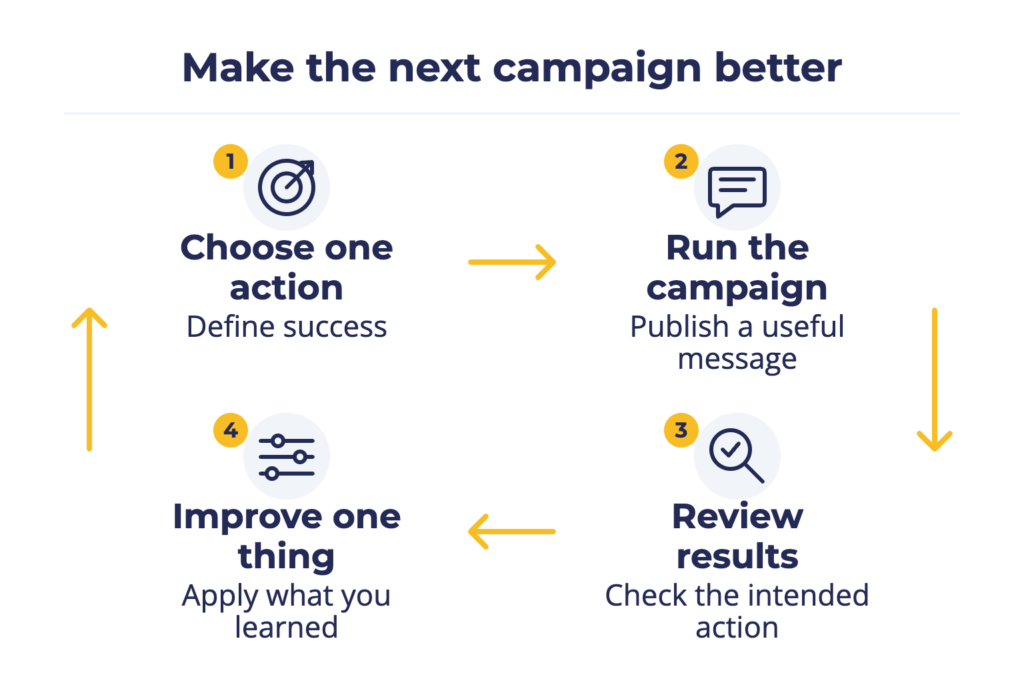
Give each campaign one primary outcome and a few supporting measures. A workshop campaign might track registrations and attendance. An onboarding campaign might track completed setup steps, where measurement is available.
Distinguish an application click from a submitted application. If another provider controls the application, confirm which results you can actually measure.
Review performance on a consistent schedule, including staff time and spending. Compare similar periods and account for seasonal offers or other changes that could influence results.
Test one meaningful change, such as the subject line or registration page. Keep what helps members complete the intended action and revise what creates confusion.
Choose one improvement to start
Select one member group, one recurring question, and one measurable action. Assign an owner, publish the supporting content, and set a review date. Expand when your team understands what works.
Use the website metrics guide to distinguish activity from outcomes, and the marketing plan to assign campaign responsibilities. Keep a simple record of the audience, message, destination, result, and lesson learned. Over time, that gives your team a practical reference for planning the next campaign with confidence.
If routine website updates keep slowing down your campaigns, explore CU Rocket's website features to understand the editing tools available to your team.
For ongoing service after joining, review the member retention journeys. Get Started to discuss the website improvements your team needs.